

Table of Contents
- The Real Cost of Custom Shirts vs. Off-the-Rack
- Custom T-Shirt Pricing Guide: What Drives the Cost
- Cost-Per-Wear: The Math That Changes Everything
- Fabric Quality and Garment Longevity: What Lasts
- Unique Gift Ideas for Sports Fans: Custom Shirts That Score
- The Hidden Costs of Tailoring Ready-to-Wear Shirts
- Sustainability and Ethical Manufacturing in Custom Apparel
- Conclusion: When Custom Shirts Are Worth It
- Frequently Asked Questions
Last Updated: September 13, 2026
The Real Cost of Custom Shirts vs. Off-the-Rack
A custom shirt is made to your specifications, measurements, fabric, or design, rather than pulled from a rack. The question of are custom shirts worth the money comes down to one comparison most buyers never run: total cost divided by actual wears.
At TL Originals, we sell custom-printed tees, so we have a bias worth naming upfront. We also know "custom" covers everything from a $22 humorous game day tee to a four-figure bespoke dress shirt.

The honest starting point: a custom shirt is worth the money when its cost per wear lands below what you would spend replacing cheaper shirts that fade, shrink, or sit unworn.
What You Actually Pay For
Two things drive the price of any custom shirt: the blank garment and the customization itself.
The blank is the shirt before anything is printed or embroidered. Better blanks use combed and ring-spun cotton, which removes short fibers for a smoother, stronger yarn; cheaper blanks use carded cotton and feel rougher.
Customization is where costs separate fast. Direct-to-garment printing applies water-based ink into the fabric fibers. Screen printing pushes thicker ink through a mesh stencil, costing less per unit at high volume but requiring setup per design.
For a custom graphic tee, most of your money goes to the blank and the print method. Fabric weight, thread count, and construction decide whether the shirt survives fifty washes or five, which is why a cheap custom shirt is rarely a bargain.
Custom T-Shirt Pricing Guide: What Drives the Cost
A custom t-shirt pricing guide starts with one rule: you pay for fabric, print method, and labor, in that order.
At TL Originals, our custom tees run from $21.99 to $23.99 depending on the design and blank. That range covers a side-seamed, unisex tailored fit and direct-to-garment printing on ring-spun cotton. No setup fees, no minimum order, no design surcharge.
Fabric Weight and Thread Count
Fabric weight is measured in ounces per square yard and tells you how substantial a shirt feels. Lighter fabric breathes better in summer; heavier fabric drapes more and holds its shape longer, though it runs warm.
Thread count gets misused constantly in apparel marketing. In shirting, it refers to threads woven per square inch. Higher counts mean a finer, smoother hand, but past a point you are paying for a delicate fabric that wears out faster, not a better one.
A practical middle ground: look for combed and ring-spun cotton, which most quality blanks use. It costs more to produce and shows up immediately in how the shirt feels and how well the print holds.
Print Method: DTG vs. Screen Printing
Direct-to-garment printing suits detailed, multi-color, or one-off designs because there is no setup cost per color.
For a single humorous tee or a small gift order, DTG is the sensible choice.
Cost-Per-Wear: The Math That Changes Everything
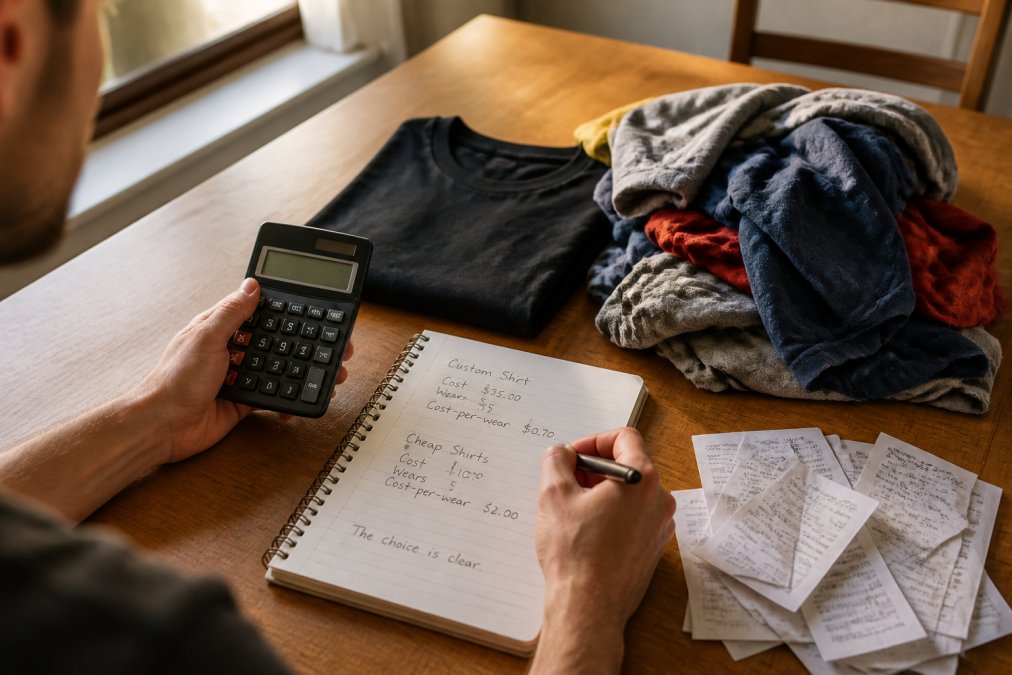
Cost per wear is the purchase price divided by the number of times you actually wear the item, the single most useful number in this decision, and almost nobody calculates it before buying.
The formula is simple, but the inputs are where most people fool themselves. You need three honest numbers: the real price paid (including alterations), realistic wears per month, and lifespan in months before the shirt stops being wearable in public.
Run the Math on Three Real Scenarios
Here is how the same $22 custom tee stacks up against the alternatives most shoppers actually consider.
Scenario 1: The bargain multipack. A three-pack of basic tees for $30 works out to $10 per shirt. If each pills, shrinks, or fades after eight washes and gets demoted to yard work, that is roughly $1.25 per wear, and replacing them twice a year climbs fast.
Scenario 2: The mid-tier retail tee. A $35 mall-brand shirt worn twice a month for two years (48 wears) lands at about $0.73 per wear, solid, but only if the collar holds and the print does not crack.
Scenario 3: The custom tee. A $22 custom shirt worn twice a month for two years (48 wears) costs about $0.46 per wear; worn weekly, roughly $0.21. The custom shirt does not win because it is cheaper up front, it wins because the wear count is higher and the replacement cycle is longer.
Body Type Changes the Answer
Run this before any apparel purchase:
- Estimate realistic wears per month
- Multiply by 24 for a two-year wear count
- Divide the price by that number
- Compare against your current go-to shirt
- Repeat using a conservative estimate
The Comparison Nobody Runs: Custom vs. Buy-Plus-Tailor
The hidden cost of tailoring ready-to-wear is that alterations rarely stop at one line item. A $30 shirt plus $15 to shorten the sleeves, $20 to take in the sides, and $12 for darts is now a $77 shirt, still cut for someone else's proportions.
The Number That Actually Decides It
If your custom shirt costs less per wear than the shirts you are replacing, it is worth the money. If it does not, it is not, no matter how good the fabric feels in the store.
Fabric Quality and Garment Longevity: What Lasts
Garment longevity comes down to fiber quality, stitch density, and seam finishing. A shirt with good fabric and weak construction fails at the seams long before the cloth wears out.
The blanks we print on use Airlume combed and ring-spun cotton in solid colors, with heather options blending cotton and polyester. Combed cotton has shorter fibers removed, reducing pilling and giving a smoother print surface.
Collar Construction and Stitching
Collar construction is where cheap shirts give themselves away. A ribbed knit collar with high-quality elastic holds its shape through repeated washing. A thin, poorly knit collar stretches into a wavy mess within months.
Look for these construction details:
- Side seams: Side-seamed shirts follow the body instead of hanging like a box
- Taped neck and shoulders: Prevents stretching at the highest-stress points
- Double-needle stitching: Reinforces hems and stress seams
- Tubular vs. side-seamed: Tubular knits have no side seam and twist more over time
Maintenance and Care: The Part Most Guides Skip
A custom shirt only pays off if it survives long enough to earn back its price. Care habits decide that more than the fabric label does, how you wash, dry, and store a shirt matters as much as what it is made of.
Washing. Turn the shirt inside out before it goes in the machine. Cold water and a gentle cycle reduce fiber abrasion and protect any print or embroidery. Hot water and heavy agitation are the two fastest ways to shrink cotton and crack a print. Use a mild detergent and skip the fabric softener, which coats fibers and can dull print colors over time.
Drying. Heat is the enemy. Tumble drying on high is the leading cause of shrinkage and collar distortion (cleaninginstitute.org). Hang dry or lay flat when you can. If you must use a dryer, choose the lowest heat setting and pull the shirt out slightly damp.
Starching and pressing. Light starch helps a dress shirt hold its shape and resist wrinkles, but heavy starch builds up in the fibers and can cause them to crack along fold lines. Press on the reverse side or use a pressing cloth to avoid scorching the print. For graphic tees, iron around the design, never directly on it.
Storage. Hang shirts on a sturdy hanger with enough shoulder width to support the seams. Folded tees should go in a drawer that is not packed tight, since compression creases fibers over time. Keep stored shirts out of direct sunlight, which fades both fabric and print.
Rotation. The single biggest longevity lever is rotation. A shirt worn every day wears out roughly seven times faster than one worn once a week (sciencedirect.com). Owning a small rotation of quality shirts spreads the wear and extends the life of every one of them.
Why This Matters for the Money Question
Durability is the bridge between fabric quality and cost per wear. Better fiber, stronger seams, and disciplined care push the wear count up, and a higher wear count pushes the cost per wear down. That is the mechanism that makes a custom shirt worth the money.
Unique Gift Ideas for Sports Fans: Custom Shirts That Score
Unique gift ideas for sports fans usually fail for one reason: the gift says nothing about the person receiving it. A generic team logo tee is forgettable. A shirt that captures how it actually feels to root for that team becomes the one they reach for every Sunday.
That is the gap TL Originals was built to fill. We make custom, humorous t-shirts for sports fans, athletes, and anyone who wants to say something with their wardrobe. Designs ship directly to your door, so there is no retail line and no hunting through a picked-over rack.
A few examples from our catalog:
- Cowboys Game Day T-Shirt - 'This Team Makes Me Drink' Unisex Tee at $23.00
- Steelers Tailgating T-Shirt - 'This Team Makes Me Drink' at $22.00
- Minnesota Vikings Fan T-Shirt - 'This Team Makes Me Drink' Design at $22.00
- The 12s Gameday Tee | Seattle Football Premium Unisex Shirt at $23.99
Each one is printed with direct-to-garment on a side-seamed, unisex tailored fit, so it reads as a real shirt rather than a stiff promotional giveaway.


| Option | Price | Fit | Best For |
|---|---|---|---|
| Cowboys Game Day Tee | $23.00 | Side-seamed unisex | Dallas fans who expect disappointment |
| Steelers Tailgating Tee | $22.00 | Side-seamed unisex | Tailgate parties and home watch parties |
| Vikings Fan Tee | $22.00 | Side-seamed unisex | The perpetually hopeful Minnesota faithful |
| The 12s Gameday Tee | $23.99 | Side-seamed unisex | Seattle's loudest section |
| Parisian Steeler Graphic Tee | $21.99 | Modern classic fit | Fans who want something nobody else owns |
The Hidden Costs of Tailoring Ready-to-Wear Shirts
Sustainability and Ethical Manufacturing in Custom Apparel
Custom apparel is not automatically the greener choice, and the industry's marketing rarely admits that. What matters is whether the shirt gets worn for years or discarded after a season.
The sustainability case for custom rests on three things. First, made-to-order production avoids the overstock problem that sends unsold inventory to liquidation or landfill. Second, better fabric and construction extend garment longevity, which is the single largest lever on a garment's environmental footprint. Third, EPA guidance on textile waste reduction documents how much material ends up in landfills from discarded clothing each year, which makes durability a waste question, not just a quality one.
Print method matters too. Water-based DTG inks and eco-conscious production reduce the chemical load compared with plastisol-heavy alternatives. Blanks made with ethically sourced materials and lower-waste knit construction move the number further.
The honest caveat: a durable shirt you never wear is still waste. Sustainability and cost-per-wear point in the same direction, and that is not a coincidence.
Conclusion: When Custom Shirts Are Worth It
Custom shirts are worth the money when the cost per wear beats the alternative and the garment actually gets worn. That is the whole test.
They are worth it when you need a specific fit that ready-to-wear cannot deliver, when you want a design nobody else is wearing, or when you are buying a gift that has to land. They are not worth it if you are buying a single shirt for one event and will never touch it again.
For sports fans, the math is unusually friendly. A humorous game day tee at TL Originals runs $21.99 to $23.99, ships straight to your door, and gets worn every weekend from September through January. That is a wardrobe staple disguised as a joke.
Frequently Asked Questions
How much should I pay for a custom shirt?
Custom shirt prices vary based on fabric, print method, and order size. For a single DTG-printed shirt, expect $22 to $30. At TL Originals, most designs range from $21.99 to $23.99. Bulk orders can lower the per-shirt cost. The key is comparing cost-per-wear, not just the upfront price. A $23 shirt worn 30 times costs about $0.77 per wear, which beats a $10 shirt that fades after three washes.
Is $40 a lot for a shirt?
It depends on what you're getting. A $40 custom shirt with premium materials and durable printing can be a better value than a $15 fast-fashion tee that loses shape after a few washes. For sports fans, a custom shirt worn every game day for a season costs pennies per wear. TL Originals offers custom shirts starting at $21.99, so you do not need to spend $40 to get quality.
What factors influence the price of custom-made clothing?
The main factors are fabric quality (100% ring-spun cotton costs more than basic cotton blends), print method (DTG vs. screen printing), design complexity, order quantity, and whether the shirt is made-to-measure or ready-to-wear. Custom t-shirt pricing also reflects labor, ethical manufacturing practices, and shipping. TL Originals uses eco-friendly DTG printing and Airlume combed ring-spun cotton, which balances quality and cost.
How does the quality of custom shirts compare to retail store options?
Custom shirts often use higher-quality blanks than mass-produced retail tees. TL Originals uses side-seamed, unisex tailored fits and 100% Airlume combed ring-spun cotton, which feels softer and holds shape longer than standard boxy tees. Retail shirts may be cheaper upfront, but custom shirts offer better fit precision, unique designs, and often better garment longevity. The trade-off is a slightly higher initial cost for a product that lasts.
If your closet is full of shirts that fit badly, faded after a month, or cost more to alter than to replace, that is the challenge worth solving. TL Originals sells custom humorous t-shirts built on side-seamed, unisex tailored fits and direct-to-garment printing, with designs made for sports fans who want to say something. Browse the catalog, pick a design, and hit Add to Cart.
